
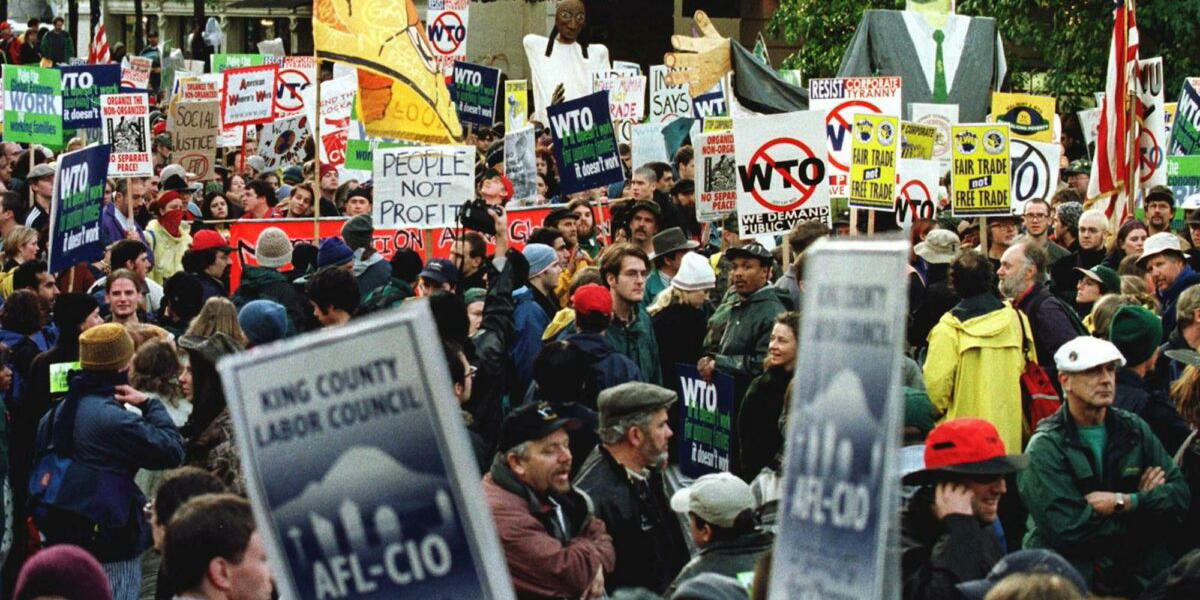
I was thinking today about the 1999 WTO protests in Seattle today. How it brought together an unlikely group of teamsters, steelworkers, Christian activists, eastern medicine defenders of human rights in Burma and China, academics, anarchists, and crust punks; and in doing so, brought an antiglobalization message into the mainstream. Rage Against the Machine’s “Sleep Now in the Fire” was the anthem. All during a Clinton economy that created 20 million jobs and a federal surplus. (There hasn’t been another since 1969 if you’re keeping score).
I thought about the same protesters, many now in their 40s and 50s, many who have benefited from the neoliberal trade consensus that Clinton cemented, Bush and Obama crowned, and became the current free-trade consensus agreed upon by everyone from a deregulation capitalist to the Community Party of China.
Maybe some of them were driving Teslas or used Prius’s home from work, listening to Scott Horsley try to quantify the consequences of Trump’s bizarre “Liberation Day” spectacle as he hoisted a chart of global tariffs in front of the White House like a roadside sign-spinner. Maybe they were still listening to Rage, thinking back to 1999 as they protested Nike’s sweat shops in Pakistan; the child labor that made basketballs; the exported environmental degradation that made it possible to be a middle class consumer in the 90s.
Teleporting personas through time is fun. But it’s ultimately deceptive. Our labels, politics, and identities are less often constants. They’re more physical. Shaped by the history we witness, our backs and necks literally hunching downward toward our phone, our attention spans now shorter than a goldfish. No, we’re never constant. We are more like rocks in a river. We may think we stay the same. But on a long enough time scale, we subtly change.
One thing that I keep coming back to is how the internet is fundamentally changing how we attempt coherence in a web of increasing global interdependency. We’re fed narratives by sign-spinning Presidents; by podcasters with Shurr microphones; by the endless cultural image regurgitation on Instagram; by journalists; by researchers; by poets. More and more we are seeing these stories collide, where our information diets are so divergently extreme that people can’t even agree on any shared understandings, let alone cause and effect.
The coherence of these stories has massive consequence. They aren’t just a billion ideas speeding along fiber optic cables deep in the ocean — making us laugh, raising our cortisol, or bouncing around in our heads like good brain rot. They decide how food gets produced, where it goes, how much water can be diverted to create it, and at what cost.
The 1999 WTO protests were only quarter of a century ago, but the ways in which we mobilized around shared stories then was more like the 1920s. What we do know now, is that whatever happens over the next 10, 30, 100 years will likely be explained in billions of different ways.