
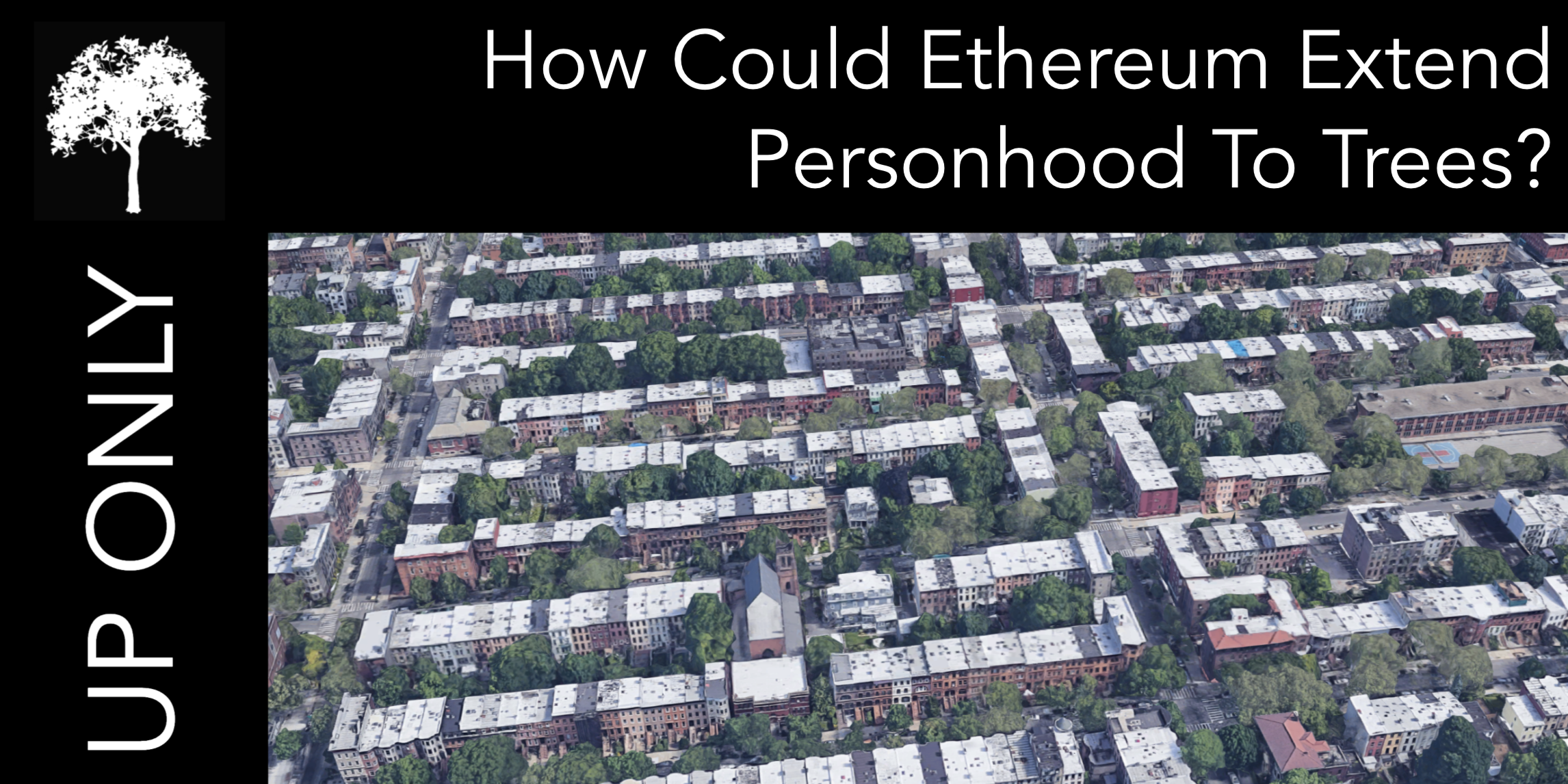
Hardly a day goes by without a news story about record-breaking droughts and floods, widespread species loss, and destruction of valuable natural resources.
As these extreme climate events touch everyone in the world, we know the stakes are high, compelling our elected representatives to come up with sweeping solutions. The enormity of the problem means that meaningful progress must start happening outside of the Paris Agreement. It will need to start within industries, bilaterally between countries, or even at a city, company, and organization level.
I’d like to share my own story about how I came to see street trees in NYC as an area to test my assumptions about Ethereum as not only a financial coordination mechanism, but an attempt to confer rights and power to non-humans.
Common Pool Resources
Why street trees? They are one of the greatest examples of common pool resources: no one owns them, but everyone benefits from them.
In economics, common pool resources (CPRs) refers to a core resource which provides a limited supply of “extractable units.” Street trees are common pool resources because they have a high level of subtractability and a high difficulty of exclusion. You can’t exclude people from benefiting from them, but they are more threatened by removal than park trees.
Perhaps you’ve come across the phrase “the tragedy of the commons.” The idea is that when humans act in their own self interest, they become uncoordinated, which results in the depletion of natural resources for all.
Elinor Ostrom’s Governing the Commons
Elinor Ostrom wrote Governing the Commons in 1990, which eventually made her the first woman to win the Nobel Prize in economics. This foundational book presents empirical examples of successful and unsuccessful efforts to govern common pool resources and makes a strong case for self-governing institutions to regulate resources.
Ostrom was strident in her critique that metaphors like “tragedy of the commons” end up becoming perverted foundations for policy. She observed “neither the state nor the market is uniformly successful in enabling individuals to sustain long-term, productive use of natural resource systems.”
She provided examples of communities relying on institutions resembling neither the state nor the market that governed natural resources with reasonable degrees of success over a long period of time, such as irrigation systems in Spain and Nepal, mountain villages in Switzerland and Japan, and fisheries in Maine and Indonesia.
In 2021 after rereading her book, I couldn’t help but think: how might Ostrom apply her self-financed contract enforcement game, given the new organizing principles in Ethereum, like self-executing contracts and DAOs?
Environmental Personhood
In recent years, there has been a growing movement to confer rights to non-humans, also called environmental personhood. Many indigenous communities already recognize nature with personhood, rather than as a commodity over which property rights should be exercised.
In 2017, New Zealand gave Mount Taranaki the same legal rights as a person. In 2019, Bangladesh became the first country to grant all of its rivers the same legal status as humans. In the same year, Toledo, Ohio voters passed legislation to allow citizens to sue on behalf of Lake Erie when it’s being polluted.
But do these new conceptions of legal rights have teeth? Who enforces them?
Starting Local: Street Trees
For anyone that has lived in a dense city, it’s easy to overlook the importance of street trees. Their leaves and bark pull carbon and pollution directly from the air. Their roots capture storm runoff. They lower temperatures on the street, and increase property values.
I discovered the New York City Street Tree Map, which contains IDs, tree data, locations, and a unique economic value for 689,227 of NYC’s street trees.
The NYC Parks department uses formulas from the USDA Forest Service’s i-Tree software to determine a unique dollar value that a tree provides citizens of New York each year. It combines various GIS methods and models to determine biomass, local air pollutants, tree diversity, weather and hydrology, and carbon storage and sequestration.
Ethereum as Payment for Ecosystem Services (PES)
The idea of issuing payments to incentivize the maintenance of common pool resources has grown as a category of conservation, also known as Payments for Ecosystem Services (PES).
Among the many benefits Ethereum has provided, one particular advantage is reducing the cost for creating and accounting the representation of an asset. What if each street tree was given a unique address on Ethereum, not as a property right, but as a contract representing the tree itself?
What if each tree’s value was associated with a token? Using the PES model, payments could be issued to people that live next to the tree, based on its current value. Importantly, you could also associate the ability for the tree itself to issue value to people living next to it.
terra0
An organization of artists and technologists called terra0 have already done this. terra0 use Ethereum and DAOs “to create technologically-augmented ecosystems that are more resilient, and able to act within a predetermined set of rules in the economic sphere as agents in their own right.”
Their installation Premna Daemon is a bonsai tree with agency, served by human operators. Human operators care for the various needs of the tree (watering, lighting, leaf trimming, etc) only when ETH is sent to the Premna contract.
It’s a powerful example that non-human agency is possible when given self-executing financial tools, and simple crowdfunding methods can turn a natural resource into a being with agency.
NYC Street Tree DAO
Inspired by PES conservation attempts using Ethereum and terra0’s Premna Daemon, I decided to test the extent to which a NYC street tree could gain financial agency by setting up a Mirror crowdfund for a singular street tree.